Total Knee Replacement at Home in Scottsdale: What Changes When a Registered Nurse Leads Recovery
Advances in minimally invasive total knee replacement techniques have shortened hospital stays considerably, and many patients now go home within hours after surgery. A shorter hospital stay does not mean a shorter recovery, it means more of the recovery, the part where complications and setbacks actually happen, takes place at home instead of under a nurse's eye on a hospital floor.
Families researching "replacement total knee" recovery timelines online often find generic checklists: ice, elevate, walk, repeat. Those checklists are not wrong; they are just incomplete. Whether your surgeon performed a partial knee replacement or a full total knee replacement, the same five milestones tend to be where recovery either keeps moving or quietly stalls, and where clinical judgment, not a checklist, makes the difference.
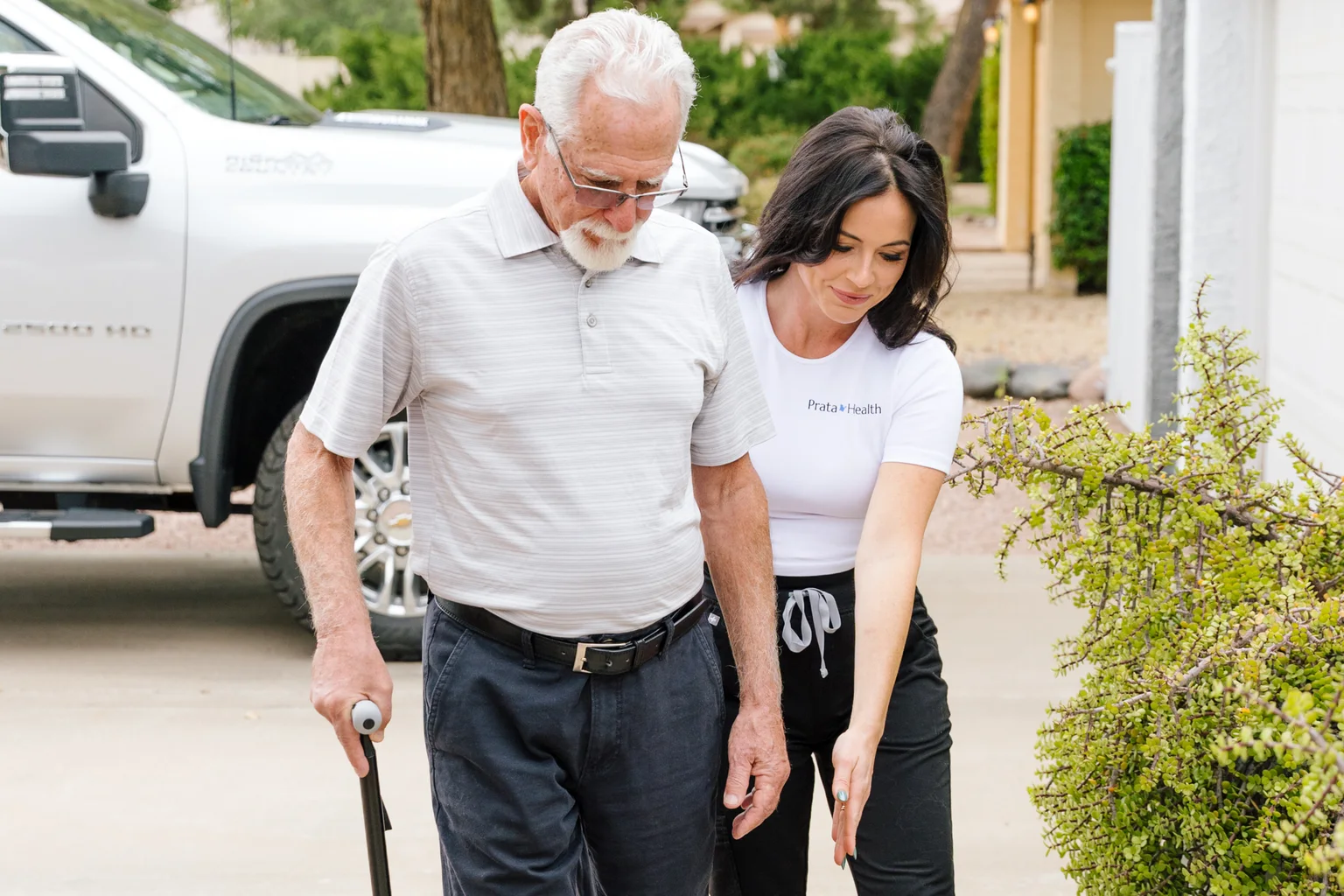
For families across Scottsdale, Paradise Valley, and the surrounding Valley, the appeal of recovering at home is real: familiar surroundings, a favorite chair, a spouse close by. But home also removes the built-in structure of a hospital floor, where a call button and a rounding nurse used to catch small problems before they grew. Concierge recovery replaces that structure with a Registered Nurse who already knows your surgical history, your home layout, and your family, so nothing about these five milestones is generic.
Milestone One: The First 72 Hours Off the Couch
The first stall point isn't medical, it's behavioral. Pain and swelling after knee replacement surgery make the couch feel safer than the hallway, but muscle stiffness sets in within hours of inactivity. Orthopedic teams generally recommend walking, even briefly, immediately after surgery, and continuing several short walks daily once home. Patients recovering without dedicated support often skip these early walks because no one is there to encourage or supervise them, and that first missed walk tends to compound into a missed week. A Registered Nurse checking in during these first 72 hours catches the skipped walk immediately, not at the two week follow up when the stiffness has already set in. Hydration, wound checks, and pain medication timing matter just as much in this window as movement does. Pain that is under-treated makes patients avoid walking altogether, while medication that is over-relied on can mask a warning sign like unusual swelling or redness around the incision that deserves a clinical eye, not a guess.
Milestone Two: The 90 Degree Bend at Week Two
Most physical therapy protocols use roughly 90 degrees of knee flexion by the end of week two as a working benchmark for on track recovery. Unlike hip replacement, which allows earlier weight bearing confidence, knee replacement recovery front loads range of motion work in the first two weeks, and that work is uncomfortable enough that patients quietly under do their exercises. Swelling that isn't managed with elevation and icing on a consistent schedule slows the bend further, and a stalled bend at week two is difficult to fully recover later without additional therapy. This is the milestone where at home nursing support matters most: watching the joint, not just asking how it feels. Scar tissue begins forming almost immediately after surgery, and the body will happily heal around a bent or a straight knee, whichever position it spends the most time in. That is the mechanical reason the 90 degree benchmark exists: it is not an arbitrary number, it is the point at which everyday movements like getting out of a chair or into a car become manageable again.
Milestone Three: Stairs Without a Railing, Weeks Three to Four
Falls during joint replacement recovery are disproportionately concentrated in this window, when independence returns faster than actual stability does. Patients living alone, or whose family cannot be present daily, often stall here out of caution rather than physical limitation, avoiding stairs, uneven ground, or getting in and out of a car longer than clinically necessary. A nurse who has followed the case from day one can tell the difference between appropriate caution and a fear response that is quietly limiting recovery, and correct course before the gap widens. Simple home adjustments, clearing loose rugs, adding grab bars near the shower, positioning a sturdy chair at the top and bottom of the stairs, remove much of the real risk in this window, and a nurse who has already walked the home knows exactly which adjustments matter for your layout.
Milestone Four: The Confidence Gap at Weeks Six to Eight
Weeks six through eight are when formal physical therapy visits often taper, and that tapering exposes a gap: the exercises still matter, but the built-in accountability of a scheduled appointment disappears. This is also when many families in Scottsdale start weighing whether ongoing support is still worth it, right as consistency matters most for translating range of motion into real function like walking a full block or standing to cook a meal. Concierge nursing in Scottsdale keeps that accountability in place at home, so the taper in formal therapy visits doesn't become a taper in effort. There is also an emotional component that rarely makes it onto a discharge checklist. Weeks of limited independence wear on even the most resilient patients, and a quiet dip in motivation around this stage is common. Having a familiar face check in, someone who remembers how far the knee has come since day one, tends to matter as much as the exercises themselves.
Milestone Five: Return to Full Activity After Month Three
The American Academy of Orthopaedic Surgeons notes that full recovery from total knee replacement is highly individual and can continue for several months even when the early milestones go well. Strength, not just motion, is usually the last piece to return, and patients frequently mistake pain free walking for full recovery, then push back into golf, travel, or grandchildren duty faster than the joint is ready for. The final stall point is often quietly declining the last round of strengthening work because the visible parts of total knee replacement at home in Scottsdale recovery already look finished. Ongoing strength, balance, and a healthy weight also protect the replaced joint for the long run and lower the odds of problems in the other knee down the road, which is why this last stretch deserves the same attention as the first.
Plan Your Total Knee Replacement Recovery With Prata Health
Every one of these five stall points is easier to catch with a Registered Nurse watching for it than with a generic checklist. Request a Consultation to build a recovery plan around your surgery date, your home, and your goals.