Most patients leave the hospital with a printed sheet listing hip precautions and a surgeon follow-up date. What those sheets rarely provide is a clear framework for the days in between: which aches are part of normal healing, which changes should prompt a call to your care team, and which require an ambulance. This guide fills that gap, week by week, with clinical context you can act on.
What Your Discharge Paperwork Does Not Cover
Hip replacement surgery is among the most successful orthopedic procedures performed today. The American Academy of Orthopaedic Surgeons (AAOS) estimates more than 450,000 total hip replacement procedures are performed in the United States each year, with the majority of patients reporting significant pain relief and restored daily function. Even so, the recovery period carries real risks that deserve serious attention at home.
Understanding how healing actually works inside the joint helps explain every instruction your surgical team gave you. During replacement surgery, a surgeon removes the damaged ball and socket and replaces them with prosthetic components. Your body then begins a layered healing process: soft tissue mends around the new hip, bone gradually integrates with the implant through osseointegration, and your neuromuscular system relearns how to coordinate movement through the altered structure. This biological remodeling takes months to complete, even when you feel dramatically better after just a few weeks. That gap between subjective improvement and actual tissue healing is exactly why so many complications arise: patients overestimate their capacity and sustain setbacks that extend recovery significantly.
Hip Replacement Recovery at Home Week by Week: The First Two Weeks
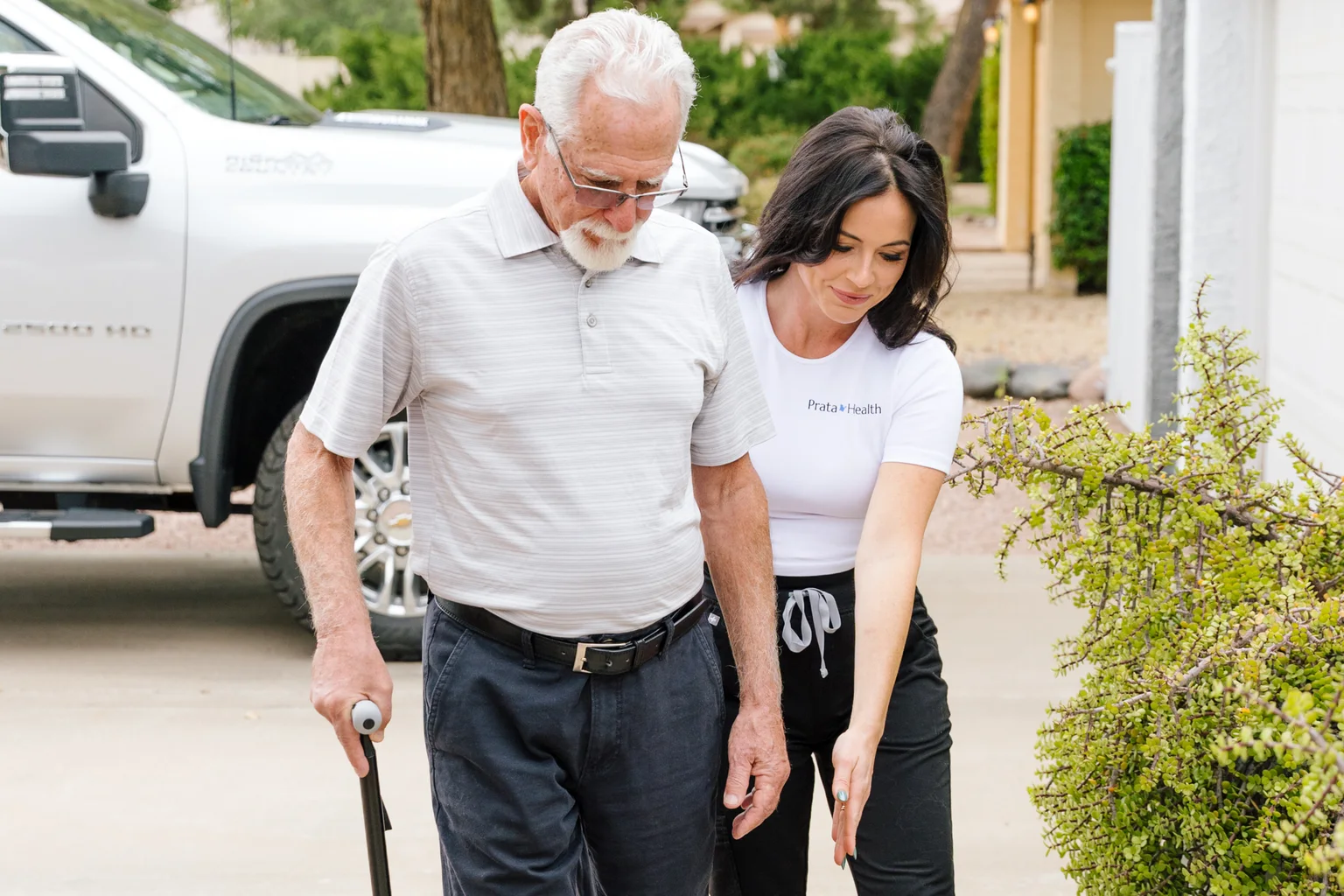
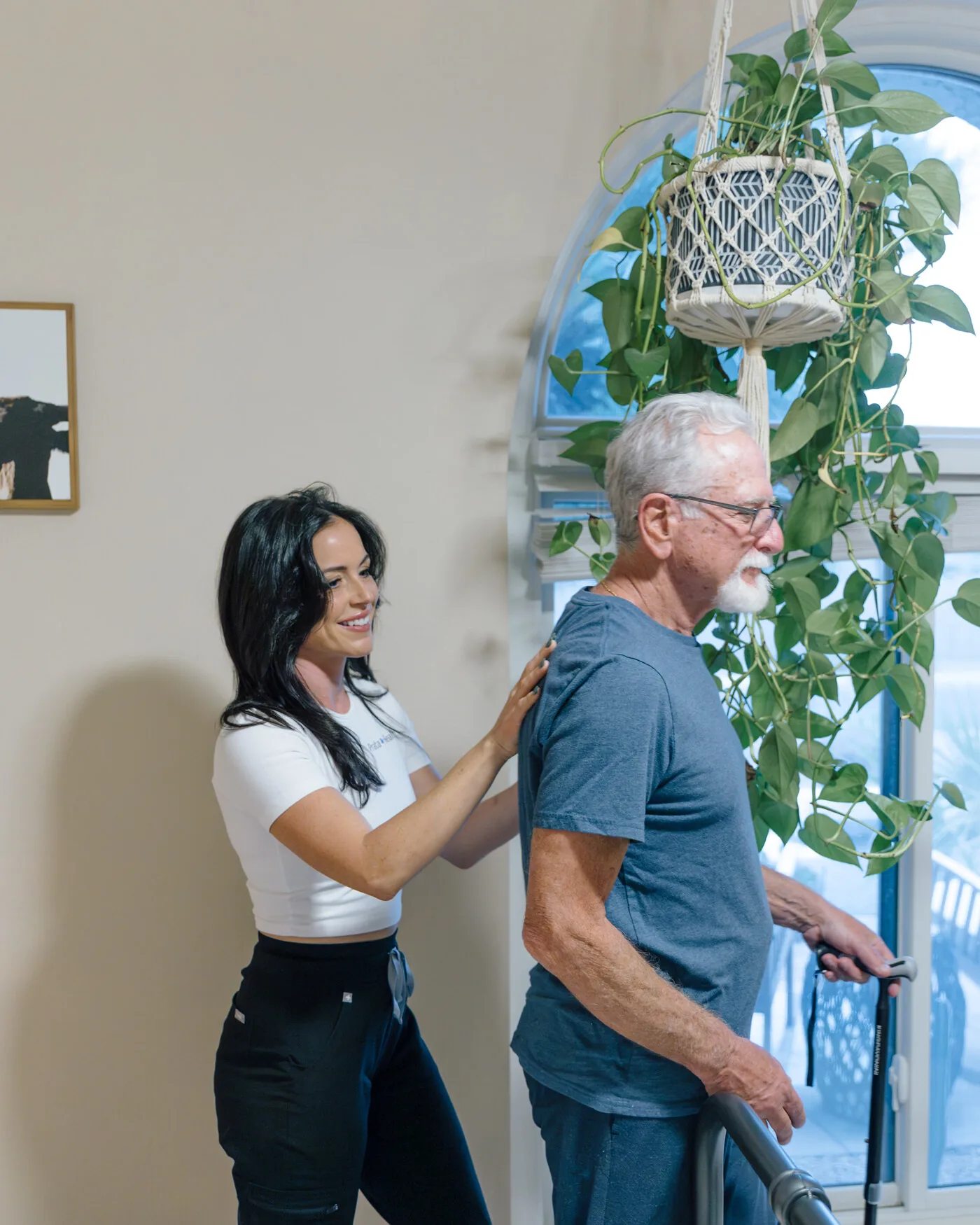
The first two weeks after replacement surgery are defined by three priorities: pain control, inflammation management, and strict adherence to hip precautions. Physical therapy begins right away, often the day of or the day after surgery, starting with gentle range-of-motion work and supervised ambulation with a walker. Your Prata nurse assists with these early movement sessions, helping you get safely up and moving while monitoring pain levels and managing surgical drains that may still be in place during the first days at home.
Most surgeons also prescribe hip precautions to prevent dislocation while the soft tissue capsule heals. Standard instructions include avoiding bending the hip joint past 90 degrees, avoiding crossing your legs, and avoiding rotating your foot inward. These rules exist because the hip capsule is vulnerable for the first few weeks, and violating them can displace the prosthetic head from the socket. Getting in and out of beds and chairs safely requires coaching from your nurse to ensure every transfer respects these limits.
Mild to moderate soreness at the incision site and along the outer thigh is expected. Swelling of the entire leg, bruising extending toward the knee, and warmth around the hip are all part of the normal inflammatory response, typically peaking around days 3 to 5 before gradually improving. If you feel a pop followed by sudden severe pain, or notice one leg appearing shorter or rotated compared to the other, call 911 and do not attempt to stand.
What Warrants a Same-Day Call to Your Nurse in the First Two Weeks
Not every concern carries the same urgency. These are the signs during the early recovery window that require a same-day call to your nurse, not a wait-and-see approach.
Worsening pain
pain increasing rather than improving after day 5, or pain that was improving and then suddenly spikes
Incision changes
edges separating, or discharge that is yellow, green, or has an odor rather than minimal and clear
Fever above 101.5 degrees Fahrenheit
does not resolve with prescribed medications
Spreading redness
redness extending outward from the incision border rather than confined to the wound edge
Surgical drain concerns
output that increases sharply, changes color, or the drain becomes dislodged
Urinary difficulty
retention or urinary tract infection symptoms are common after anesthesia and catheterization and respond well to prompt evaluation
Unusual fatigue or dizziness
can signal anemia from surgical blood loss or medication side effects, both manageable when caught early
Weeks 3 to 6: Physical Therapy Advances and Rebuilding Strength
By weeks 3 to 6, physical therapy that started right after surgery now advances significantly. Patients progress from a walker to a cane to unassisted walking during this window, and the therapy program expands to include more demanding strengthening and range-of-motion work. The AAOS 2023 clinical practice guideline on management of hip osteoarthritis finds that structured rehabilitation after total hip arthroplasty, whether formal physical therapy or a guided home-exercise program, is supported by strong evidence to improve range of motion, pain, walking speed, and overall function. Your Prata nurse coordinates directly with your physical therapist during this phase, monitoring wound healing, assessing gait quality, and catching early warning signs before they escalate. The typical elements of this advancing program include:
Gait retraining progressing from a walker to a cane to unassisted walking as strength and balance allow
Hip abductor strengthening to support the pelvis during movement and protect the new joint
Quad sets and straight-leg raises to rebuild lower extremity function without stressing the hip capsule
Range-of-motion exercises carefully performed within your surgeon's hip precaution limits
Supervised ambulation outdoors, advancing to stairs and uneven surfaces as cleared by your clinical team
Blood Clots and Signs That Require a 911 Call
Blood clots are among the most serious complications following replacement surgery. A deep vein thrombosis (DVT) forms when blood pools in the deep veins of the legs, most often because surgical trauma, anesthesia, and reduced mobility combine to slow venous return. The AAOS and the Agency for Healthcare Research and Quality (AHRQ) both recognize venous thromboembolism as a primary risk after total hip arthroplasty, which is why anticoagulation therapy is standard post-operative care at major orthopedic programs. Your nurse will help you stay consistent with prescribed anticoagulants and watch for early signs that warrant escalation.
Symptoms that may indicate a blood clot include calf pain or tightness not present before surgery, one leg significantly more swollen than the other, and skin on one leg appearing red, warm, or discolored compared to the other. If a DVT travels to the lungs as a pulmonary embolism, signs include sudden shortness of breath, chest pain, a rapid heartbeat, or coughing up blood. Any of these require a 911 call immediately.
Additional 911 emergencies include sudden severe pain with a pop at the hip (possible dislocation of your new joint), complete inability to bear weight when you were previously walking, chest pain of any kind, and confusion or loss of consciousness.
How a Prata Nurse Supports Every Stage of Hip Replacement Recovery
A skilled nurse at home during hip replacement recovery is not a luxury addition. It is a clinical layer that makes the difference between a complication caught in its early stages and one that lands you back in the emergency department.
From the first day home, your Prata nurse manages pain medication so your regimen stays effective and safe, empties and monitors surgical drains, and assists with ambulation so every time you move through the house is done with proper technique. As recovery advances, your nurse tracks incision healing against objective benchmarks, monitors gait quality as therapy progresses, coordinates directly with your surgeon and physical therapist, and keeps your family informed with clear clinical updates.
The continuity matters as much as the clinical skill. A nurse who has assessed you every week for six weeks knows your baseline. She notices when something has quietly shifted before it becomes a crisis. That longitudinal knowledge is what a rotating aide or a once-a-month physician check-in cannot replicate.