By Bianca Fabbo, MSN-ed, RN, AMB-BC
The question of home or rehab after a hip or knee replacement in Scottsdale is one orthopedic care teams are answering differently than they did a decade ago. Research has steadily shifted the consensus: most eligible patients recover as well, or better, at home, provided the clinical transition is managed carefully. What follows is an honest look at the evidence, the criteria surgeons use to guide that decision, and what a concierge RN provides that a facility simply cannot replicate.
What the Evidence Says About Home Recovery After Joint Replacement
Published research and orthopedic guidelines have been moving in a consistent direction for several years. A 2020 review published in the Canadian Medical Association Journal examined same-day discharge for total hip and knee replacement and concluded that, when patients are selected appropriately, rates of adverse events and functional outcomes are comparable to those seen with standard inpatient-protocol arthroplasty, provided clinical support is confirmed before discharge.
The American Academy of Orthopaedic Surgeons, through its OrthoInfo patient resource on outpatient total joint replacement, describes home discharge as clinically appropriate when a support system is in place, the home environment is safe and accessible, and clinical follow-up is arranged. Surgical teams in Scottsdale and across the country have incorporated same-day and next-day discharge protocols for joint replacement into standard practice.
The mechanism behind those outcomes is straightforward: the home environment reduces exposure to hospital-acquired infections, allows rest on the patient's own schedule, and supports earlier reintegration into familiar routines. Those advantages hold only when clinical oversight travels home with the patient.
Who Qualifies for Home Recovery After Joint Replacement?
Not every patient is a fit for home discharge. Surgeons evaluate several factors in the weeks before hip replacement or knee replacement surgery to determine which setting best supports a safe recovery. Understanding those criteria helps families plan well before the day of surgery.
Physical criteria surgeons commonly assess include the ability to bear weight and transfer safely within a few hours of the procedure, stable vital signs and manageable pain before leaving the surgical center, and the absence of significant intraoperative complications such as excessive blood loss or cardiac events. The home environment itself matters: an accessible layout, ideally with a bedroom on the ground floor, is a practical prerequisite.
Patient characteristics that support home discharge include a strong baseline functional status before surgery, a responsible adult caregiver present for at least the first 48 to 72 hours, cognitive clarity to manage medication schedules and recognize warning signs, and a skilled nursing care plan arranged before the day of surgery so clinical oversight begins immediately after the patient arrives home.
Partial knee replacement, which replaces only the damaged compartment of the knee rather than the entire joint, typically involves less tissue disruption than total knee replacement and carries a faster rehabilitation arc. Many partial knee replacement patients are excellent same-day discharge candidates. Even for total knee replacement and total hip replacement, ambulatory surgery centers in Scottsdale regularly discharge appropriate patients within four to six hours of the procedure. Patients with significant medical complexity, including poorly controlled diabetes, morbid obesity, or cardiac instability, are generally better served by a facility setting for the immediate post-operative period.
What a Concierge RN Provides That a Facility Cannot
Inside a skilled nursing facility, a single nurse may be assigned to eight to twelve patients simultaneously. Wound checks, vital sign assessments, and physical therapy sessions occur on the facility's schedule, not the patient's.
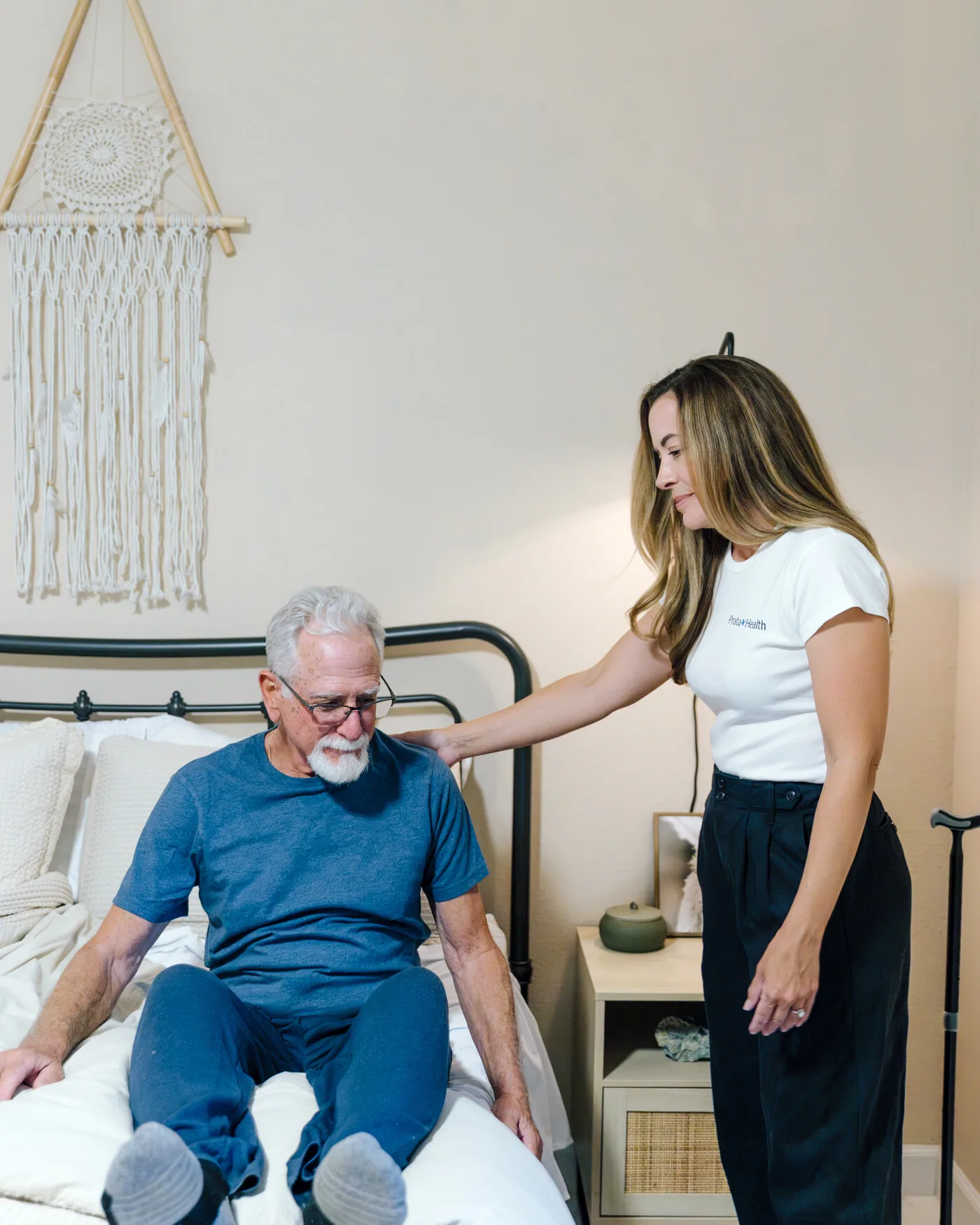
At home, an RN from Prata Health focuses entirely on one patient. She arrives when the clinical situation requires it, stays until the assessment is complete, and communicates directly with the surgical team if anything changes. This level of individualized attention is not available on a general inpatient floor.
The Agency for Healthcare Research and Quality (AHRQ) has consistently identified early detection of clinical deterioration as the primary lever for preventing avoidable emergency department visits and readmissions in post-surgical patients. A nurse who has been present from day one notices subtle shifts in wound appearance, drainage volume, or pain character before those changes escalate into complications. That early-warning function is the core clinical value of RN-led home recovery.
Clinical Tasks a Home-Based RN Manages During Acute Recovery
The scope of work a registered nurse performs during the first weeks at home extends well beyond wound checks. Each of the following represents a clinical function that falls outside what a home health aide or family caregiver can safely perform independently.
Wound assessment
identifying early signs of infection, hematoma, or incision separation before they escalate to the surgical team level
DVT surveillance
monitoring for calf pain, swelling, and warmth, and escalating to the surgical team or emergency department when clinical signs are present
Medication management
reconciling anticoagulants, pain medications, and surgical drains management, and reviewing existing prescriptions to prevent interactions and ensure consistent adherence
Physical therapy reinforcement
supporting the home exercise program prescribed by the patient's physical therapist and ensuring exercises are performed safely and correctly at each stage
Pain management coordination
tracking analgesic requirements, communicating with the prescribing team, and adjusting the pain plan within established clinical parameters
Patient and caregiver education
teaching both patient and caregiver how to recognize red flags, manage wound dressings, and support safe daily movement throughout the recovery arc
Week-by-Week: What to Expect During Home Recovery
Recovery timelines vary by procedure, patient health, and rehabilitation consistency. The following reflects general guidance based on AAOS and clinical practice standards and should not replace your surgeon's specific instructions.
Weeks 1 and 2 represent the acute phase. Pain and swelling are typically at their highest in this window. Walking begins immediately, using a walker or crutches for support, because physical therapy starts on the day of or the day after surgery. Exercises in this phase focus on range of motion, strength activation, and blood clot prevention. A visiting RN or physical therapist should assess the patient daily or every other day during the acute phase.
Weeks 3 through 6 mark the early rehabilitation advancement phase. Physical therapy, which has been ongoing since surgery, advances in intensity during this window. Most patients transition from a walker to a cane around weeks three to four, depending on strength and balance. Therapy sessions become more demanding, targeting the muscle groups around the hip or knee joint. Stair negotiation is a key therapy milestone. Driving is typically restricted for four to six weeks following procedures on the right side.
Weeks 6 through 12 bring progressive return. Many patients return to sedentary or light-duty work between weeks six and eight. Strengthening exercises replace basic range-of-motion work. Swimming and stationary cycling are commonly approved before higher-impact activities. Full return to recreational activities generally occurs between three and six months.
The recovery arc for total knee replacement tends to run slightly longer than for total hip replacement, largely because quadriceps rehabilitation is more demanding. Partial knee replacement patients often reach functional milestones two to four weeks ahead of those recovering from total knee replacement.
When a Rehabilitation Facility Is the Right Choice
Home recovery is not appropriate for every patient, and a knowledgeable clinical team will say so plainly. A rehabilitation facility is the more appropriate setting when any of the following apply:
The patient lives alone with no reliable caregiver available for the first critical days after discharge
The home environment cannot be made safe without significant modification on short notice, including stair access with no ground-floor sleeping option
Medical complexity requires around-the-clock nursing observation that a visiting RN schedule cannot fully provide
The procedure involved complications that warrant close post-acute monitoring, including excessive intraoperative blood loss or post-operative hemodynamic instability
The patient or family expresses strong concern about managing recovery without continuous on-site staff, regardless of objective clinical eligibility