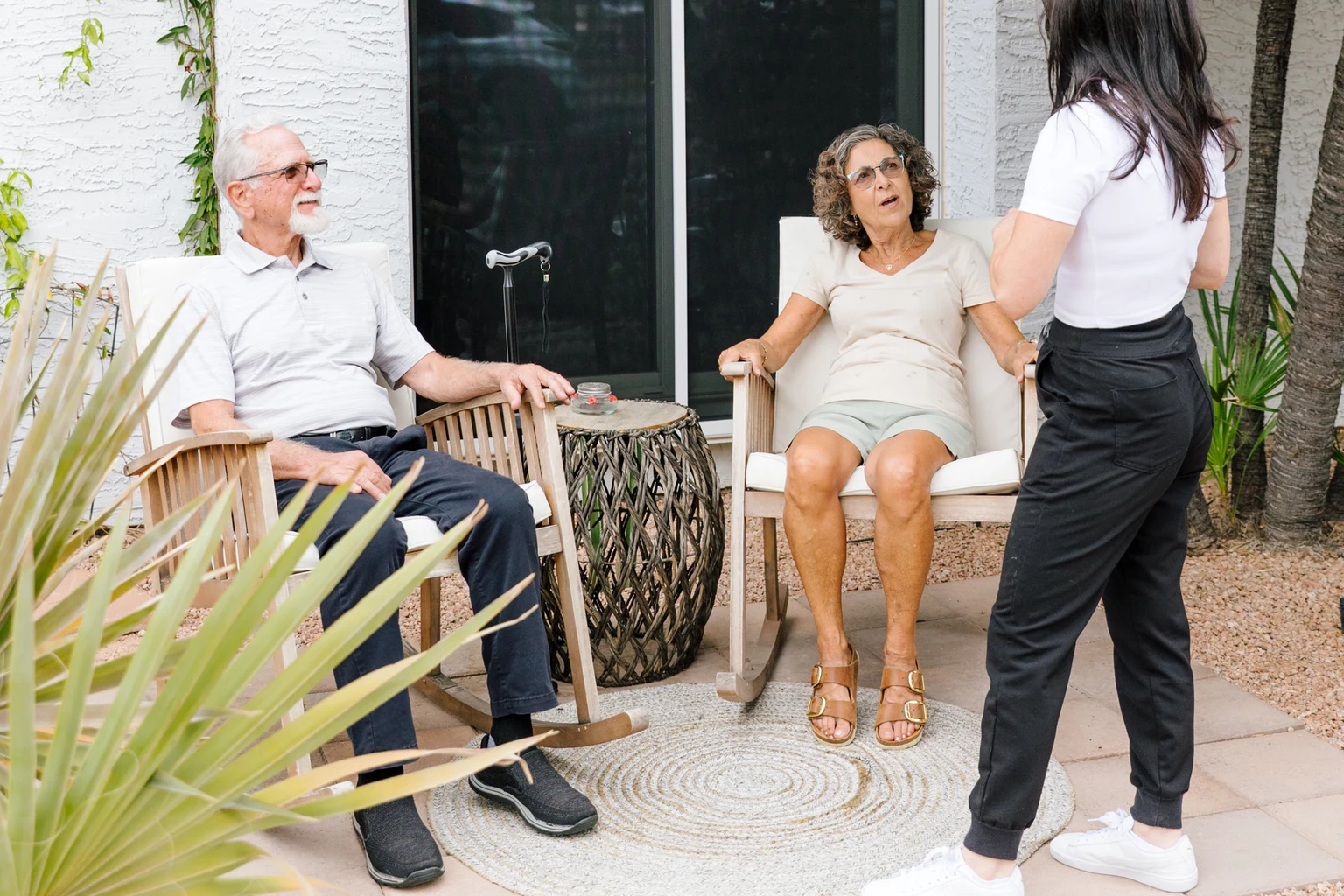
Aging in place nursing from Prata Health offers a clinically supervised option that keeps your loved one home without sacrificing safety or oversight. This article is designed to help your family compare each path honestly, so that whatever you decide, you are deciding with full information rather than under the pressure of a crisis.
By Bianca Fabbo, MSN-ed, RN, AMB-BC
What Each Level of Care Actually Provides
Each care setting occupies a distinct place in the continuum. Understanding what each one is designed to do, and what it is not designed to do, is the starting point for any honest comparison.
Aging in Place
remaining in a familiar home environment with professional support for daily tasks, medication management, and clinical monitoring by a concierge RN who coordinates care in real time rather than around a facility schedule
Assisted Living
a residential setting for older adults who need help with activities of daily living such as bathing, dressing, or meal preparation, with around-the-clock staff, structured programming, and transportation to appointments, typically delivered by certified nursing assistants rather than registered nurses
Memory Care
a specialized form of senior living designed for older adults experiencing significant cognitive decline or Alzheimer's disease, with secured environments, structured daily routines, and staff trained specifically in cognitive support
Aging in Place: What Concierge Nursing Adds to the Picture
Aging in place means staying in a familiar home environment while receiving professional support for daily tasks, medication management, and clinical monitoring. With a concierge RN, care is coordinated in real time rather than scheduled around a facility's broader census. Families consistently identify continuity of environment, predictable routines, and one-to-one attention as among the most important factors in a loved one's wellbeing.
Prata Health's Health Navigation service builds a full clinical picture before any care plan begins. A registered nurse reviews current functional status, tracks changes across visits, and communicates directly with the attending physician, so every care decision is grounded in objective data rather than a family's best estimate. This is the clinical architecture that makes aging in place viable for a wider range of needs than most families initially assume.
How Cognitive Decline Changes the Decision
For a loved one who is physically limited but cognitively intact, both assisted living and aging in place represent appropriate options depending on personal preferences and care needs. The calculation shifts substantially when memory loss enters the picture.
Early-stage cognitive decline often appears manageable from the outside. Wandering risk, medication errors, and the safety of daily tasks such as cooking or managing appliances become serious concerns as the condition progresses. Memory care assisted living settings address these risks through secured environments and purposeful architectural design that a standard home requires deliberate modification to replicate.
That said, not every person with early memory loss requires facility placement. The Alzheimer's Association reports that most people living with Alzheimer's disease and related conditions remain in the community rather than in institutional settings, with family members providing much of the daily support. Adult children and spouses often carry this responsibility without adequate professional guidance, which is where a concierge RN adds structure and accountability to what would otherwise be an improvised system.
Establishing a clinical baseline early, before a crisis forces the conversation, gives families substantially more options. A nurse can assess the home environment, adjust the care plan as cognition shifts, and identify the point at which care needs genuinely exceed what home-based support can safely provide.
Weighing Costs and Continuity Across All Three Options
Long-term care costs vary considerably across all three settings, and the comparison is frequently misread because facility pricing rarely reflects the full cost of care.
Assisted living communities charge a base monthly rate, but services provided at higher levels of need, including skilled nursing visits, specialty therapies, and additional personal care, often carry separate fees. Memory care assisted living commands a premium because of specialized staffing and secure infrastructure. Home-based concierge nursing bundles clinical oversight, care coordination, and family communication into a consistent fee structure without per-service add-ons that accumulate through a billing cycle.
Beyond cost, continuity is a critical and underweighted factor in senior living decisions. Research compiled by the National Center for Assisted Living (NCAL) and LeadingAge has documented persistently high staff turnover across the assisted living sector. For older adults with cognitive decline, repeated introductions to unfamiliar staff disrupt the trust and familiarity that support cognitive stability. For a person whose memory is already compromised, continuity of relationship is not a comfort feature. It is a clinical variable with measurable consequences.
At Prata Health, one RN builds and maintains the relationship with your loved one across every visit and every health transition. That is not incidental to the care model. It is the model.
When Memory Care Assisted Living Is the Right Answer
There are circumstances where a memory care community is genuinely the most appropriate fit, and choosing a facility does not mean a family has failed their loved one. Care needs that exceed what home-based staffing can safely address include:
Severe wandering behavior with elopement risk that requires a secured environment to manage safely around the clock
Complete dependence on others for all activities of daily living, to a degree that around-the-clock supervision cannot realistically be sustained at home
Behavioral expressions of cognitive decline that require trained physical redirection and specialized programming beyond what a home environment can provide
A care burden that has exceeded what family caregivers can sustain, even with professional support layered in
What Memory Care Communities Offer When the Need Is There
Memory care assisted living facilities offer clear advantages when those conditions are present: secured environments designed for safe movement, structured therapeutic programming calibrated for older adults with cognitive impairment, peer community, and on-site access to health services. The Alzheimer's Association's care practice recommendations emphasize that consistent, specially trained staffing and person-centered care are foundational to quality outcomes for people living with cognitive impairment. This guidance supports the principle that matching the care environment to the actual clinical diagnosis produces better outcomes over time than defaulting to whichever option is most familiar or least expensive.
Prata Health supports families through the evaluation and transition process when facility placement is the right clinical outcome. Our nurses provide discharge planning support, liaise with the receiving facility's medical team, and continue to serve as an independent clinical advocate once your loved one is in the new setting, so the relationship and oversight do not end at the facility door.